
Deal alerts are only useful after the math clears.
A sharper Endurance buyer guide for resellers who need alert speed, category context, Gargantua AIO research, and a clear way to decide whether the membership earns its keep.
Affiliate disclosure: this site may earn a commission if you join Endurance through our Whop link.
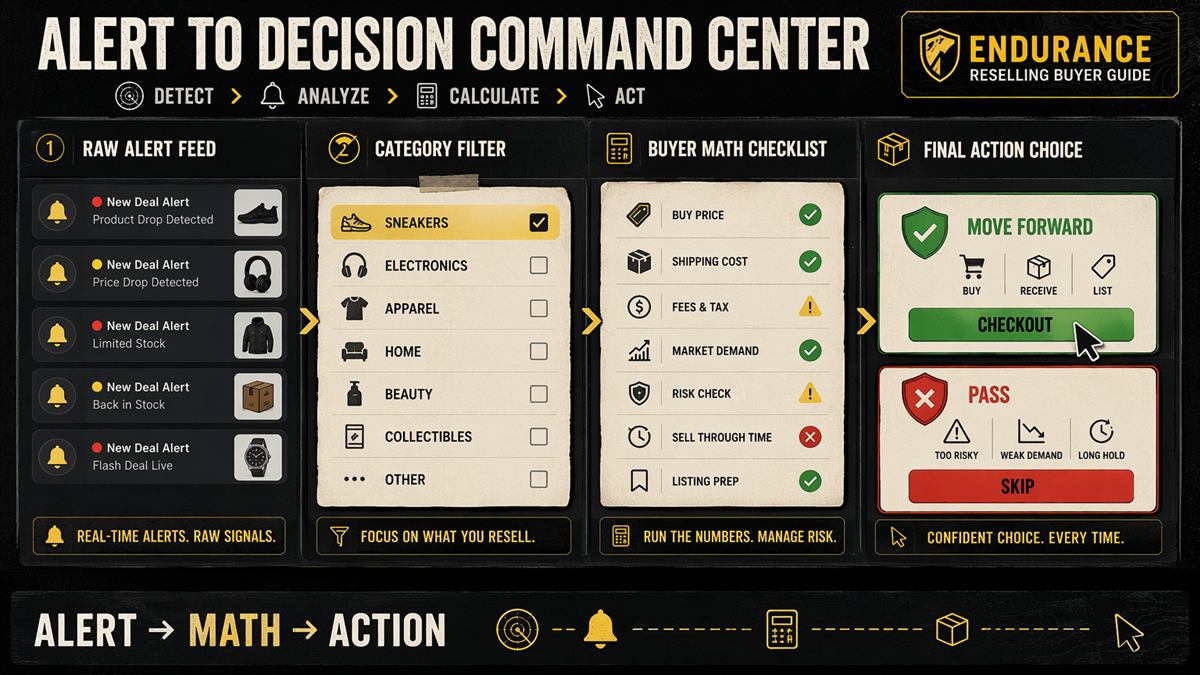
Do not join because the page is loud. Join only after you know what you are testing.
Open the live Whop listing in one tab and the trial checklist in another. Current pricing, plan details, and included access should come from Whop before any subscription decision.
The expensive lie is simple: "fast alert" means "good buy."
That lie is why resellers overbuy. They see speed and mistake it for certainty. A monitor pings, a channel lights up, a product looks scarce, and the brain fills in the rest: somebody else wants this, so I should want it too. That is not analysis. That is crowd pressure wearing a spreadsheet costume.
Endurance becomes interesting only when you judge it as infrastructure. The useful question is not "does it send alerts?" The useful question is whether the alerts arrive with enough context for you to make better decisions than you would make alone: what category is this, what is the real cost, how fast does it sell, what are the fees, what happens if the market moves, and what should you skip?
This page is built around that one correction. It does not sell the fantasy that a paid community prints money. It sells the test: can Endurance reduce search time, widen deal coverage, improve timing, and help you make cleaner buy-or-skip calls across sneakers, collectibles, electronics, food deals, e-deals, and FBA leads?
Alert drops
Buyer rushes
Math comes later
Monitor
Filter
Calculate
Execute
Review
If the alert feels urgent, slow down enough to run the buyer math.
The useful buyer is not the fastest buyer. The useful buyer knows landed cost, fee drag, sell-through risk, and what would make the deal a skip.
A paid group wins only when the equation beats the fee.
The offer gets clearer when you split it into four levers: dream outcome, likelihood, time delay, and effort. Endurance can help with all four, but none of them are automatic. A reseller still needs judgment. The page should make that obvious enough that the wrong buyer leaves and the right buyer arrives sharper.
Dream outcome
A faster way to notice deals before manual browsing catches up.
A faster alert still needs a good product, capital, and an exit path.
Likelihood
Use Whop proof, founder context, category coverage, and your own trial log.
Public reviews prove satisfaction, not your personal ROI.
Time delay
You can test one category in a week instead of debating for a month.
Some categories need longer sell-through windows before you know real value.
Effort and sacrifice
Monitors, channels, and Gargantua context reduce manual searching.
They do not remove decision work, fee math, shipping, returns, or discipline.
The mechanism is not "alerts." It is alert-to-decision compression.
A good lander needs a picture the reader can hold. Here is the picture: Endurance can compress the distance between "something happened" and "I know whether I should act." That is the whole story. Monitors reduce discovery delay. Category channels reduce context hunting. Gargantua AIO research may reduce execution friction. Buyer math prevents the speed layer from turning into expensive chaos.
Signal
Monitor finds movement before manual browsing.
Context
Category channel tells you what kind of opportunity this is.
Math
Cost, fees, shipping, resale, savings, rank, and risk get checked.
Action
Buy, bot, save, list, or skip. The skip is part of the system.
The only price that matters is the one your log can beat.
Pricing pages tempt people into the wrong argument. The fee is not the real question. The real question is whether Endurance helps you create enough realized profit, useful savings, saved time, or avoided mistakes to justify renewing. A paid group that makes you faster at bad decisions is not cheap. A paid group that stops one bad buy can be worth more than its loudest alert.
Break-even
Write the current Whop price in your log before you click. If the price changes, the math changes.
Proof period
Test one niche for seven days. Do not let a sneaker miss contaminate your food-deal verdict.
Renewal rule
Renew only when the log shows value. Cancel when the log shows entertainment.
Got a break-even number? Now judge Endurance against that number, not against hype.
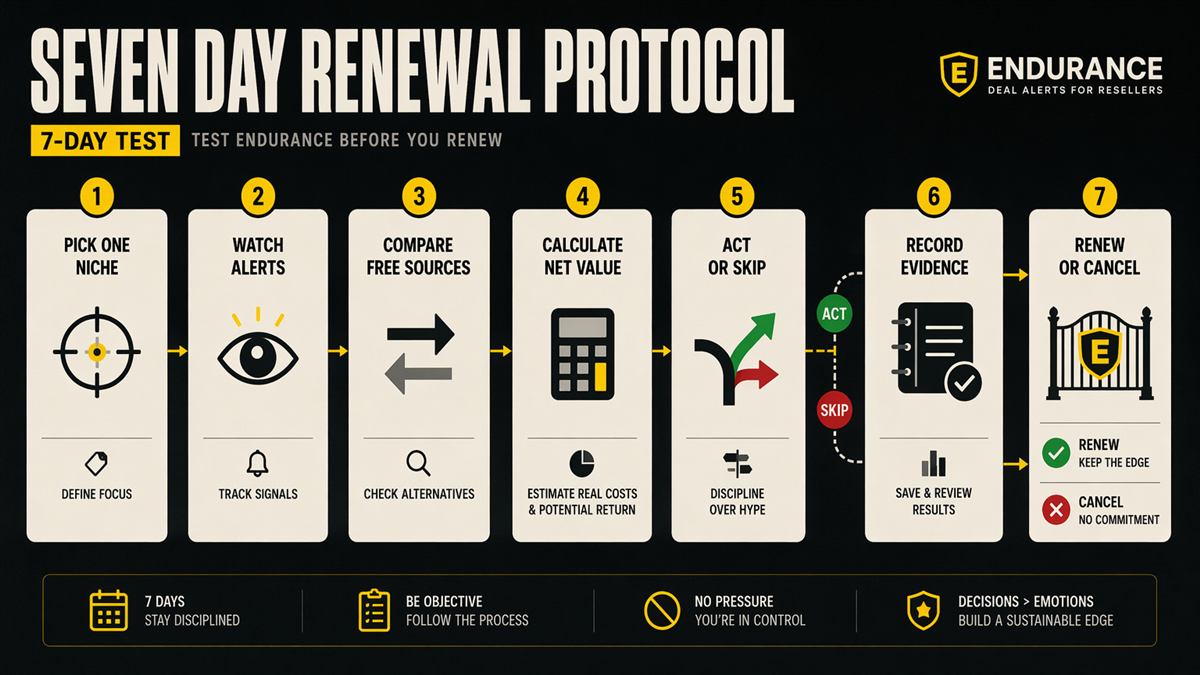
The clean test is simple: one niche, seven days, tracked alerts, tracked skips, tracked wins, and a renewal decision made from the log.
Proof has levels. Treat each level differently.
The old version of this kind of page would throw testimonials, member counts, review numbers, and profit screenshots into one pile. That is weak persuasion because it asks the reader to believe everything at once. A better page separates proof by how hard it is to fake and how close it is to the buyer's own decision.
Vague claims
Best community. Huge profits. Easy wins.
Ignore unless proved.
Public marketplace signals
Rating, reviews, joined count, price, plan terms.
Check live on Whop.
Specific workflow proof
A trial log showing alerts, skips, buys, net results.
Make your own.
Time-based outcomes
Renewal decision after tracked wins, losses, and saved time.
This is the real test.
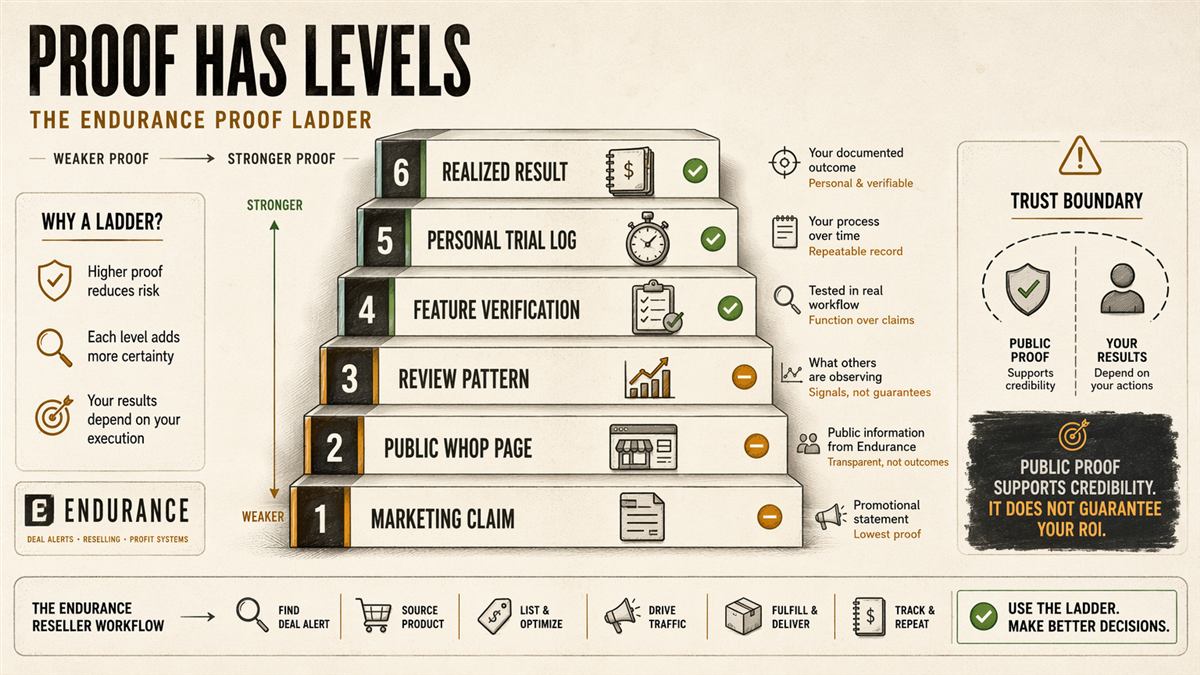
Public proof can justify a test. It cannot prove your personal ROI.
Reviews, joined count, and founder context matter. They are still not substitutes for your own category fit, budget, timing, and sell-through reality.
A seven-day test beats a month of guessing.
The first week should be boring in the right way. Pick one category. Track every alert that looked actionable. Write down why you bought, skipped, or missed. Compare it against free sources. Endurance only earns the renewal if the log shows real value, not because the Discord felt busy.
Pick lane
Choose one niche so the test has a target.
Watch
Watch Endurance alerts without buying from pressure.
Compare
Check whether free sources found the same leads.
Calculate
Run cost, fee, shipping, resale, and time math.
Act/skip
Buy only when the exit path is clear.
Record
Log wins, misses, skips, and false positives.
Renew?
Renew only if the evidence beats the fee.
One community. Different buying rules.
The page should not pretend a sneaker restock, a Pokemon box, a food deal, and an FBA lead are the same opportunity. The reader needs to see the map before the CTA. That visual map lowers cognitive load because it tells the buyer what kind of thinking each alert requires.
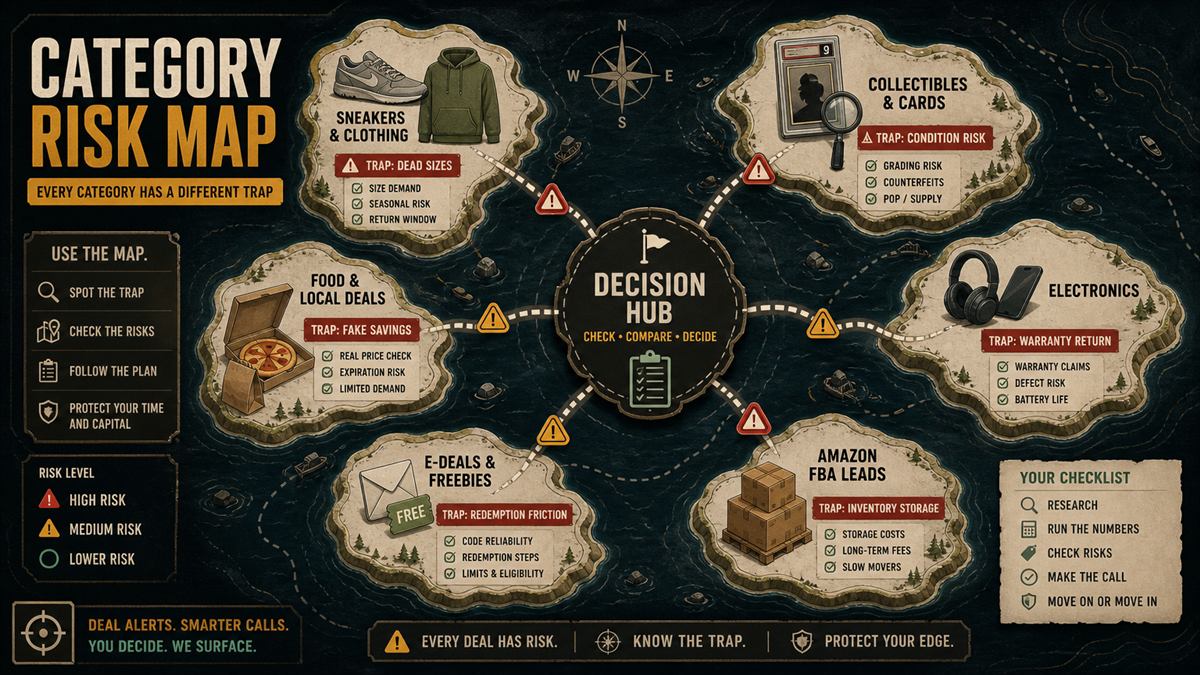
Sneakers & clothing
Alert trigger: Restocks, shock drops, raffles
Decision math: Size demand, sell-through, fees, return rate
Trap: Hype hides dead sizes.
Collectibles & cards
Alert trigger: Pokemon, sealed products, limited releases
Decision math: Condition risk, liquidity, shipping protection
Trap: Comps can move before delivery.
Electronics
Alert trigger: Clearance, bundles, price errors
Decision math: Warranty exposure, marketplace fees, fraud risk
Trap: Cancellation and return rules matter.
Food & local deals
Alert trigger: Coupons, app promos, stacked discounts
Decision math: Only count savings on normal purchases
Trap: A free meal is not profit.
E-Deals & freebies
Alert trigger: Rebates, credits, low-capital offers
Decision math: Redemption rules, account limits, time cost
Trap: Small wins can burn hours.
Amazon FBA leads
Alert trigger: Retail arbitrage and replenishable leads
Decision math: Amazon fees, rank, storage, prep, cash cycle
Trap: Inventory can become a parking lot.
The CTA should qualify the click before it asks for it.
A strong affiliate page does not try to convert everyone. It tries to convert the reader who can actually use the product. That is better for the reader, better for the vendor, and better for long-term commission because mismatched buyers churn, complain, refund, or blame the tool for a workflow they never had.
Passed the decision tree? Use the Whop page as the checkout checkpoint.
If you failed a branch, read the matching guide first. If you passed every branch, the next useful action is verifying the live listing and writing down the cancellation rule.
The page needs a descent, not a feature dump.
The writing research says depth is not a stack of facts. It is a nest: each layer changes how the reader understands the layer before it. For Endurance, the descent starts with an alert group and ends with the reader judging their own buying discipline. That is more persuasive than a giant list of categories because it changes the frame.
The surface
A paid group sends deal alerts.
This is where bad pages stop: feature, feature, feature.
The problem
The alert is not the value. The decision after the alert is the value.
A bad buyer thinks speed equals profit.
The inversion
Endurance is worth testing only if it makes you more selective.
The right user skips more often, not less.
The mirror
If you want a group to remove judgment, you are the risk.
The page turns the audit back on the reader.
The clean exit
Use one niche, one week, one spreadsheet, one renewal decision.
Now the CTA is a test plan, not pressure.
Show the moment the money is actually won or lost.
The real scene is not a neon Discord feed. It is 10:42 at night, one tab open to a marketplace, one tab open to fees, one hand hovering over checkout, and a product photo that looks more convincing than the math underneath it. That is where Endurance either helps or it does not. If the alert gives you speed but no discipline, the alert is a trap. If the alert gets you to the right calculation faster, the alert has done real work.
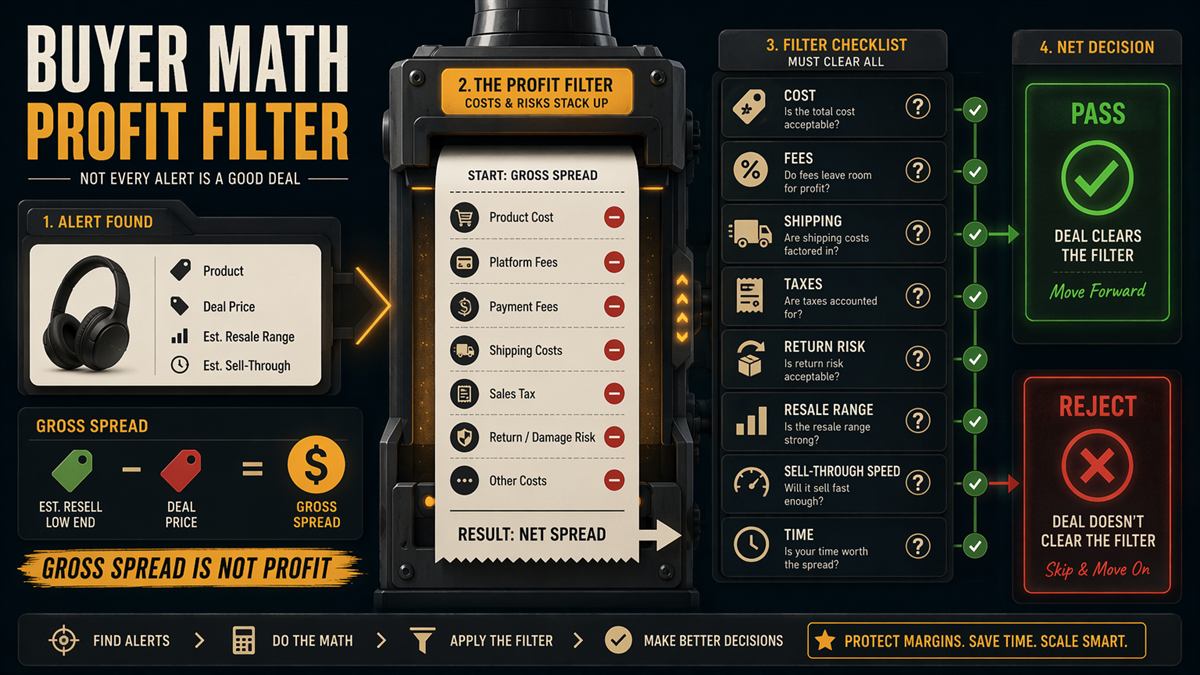
That is why this lander now uses diagrams instead of decorative images. A picture of a command center says "busy." A decision tree says "here is where you stop." A proof ladder says "do not overread reviews." A math table says "gross spread is not net profit." A seven-day protocol says "do not buy a yearly plan because the page made you excited for forty seconds."
The buyer should feel the shift: first they came looking for a verdict on Endurance, then they realized the real verdict is on their process. Can they pick one niche? Can they move fast without rushing? Can they log misses without pretending they were wins? Can they count savings only when the purchase was already planned? Can they use Gargantua as an execution layer instead of a permission slip to stop thinking?
That story is tougher than hype and more useful than caution. Hype says join. Caution says be careful. This page says: here is the operating room, here are the instruments, here is the checklist, here is where people usually bleed money, and here is the clean way to test the tool without lying to yourself.
No alert is profit until the item sells, the saving was real, or the mistake was avoided.
Read the offer like an operator, not a fan.
Endurance is easiest to misunderstand when the page only shows alerts, tools, and community energy. The sharper story is slower: a reseller notices an opportunity, checks whether the opportunity fits a lane, calculates whether the spread survives fees, uses the right execution method, and then records whether the result was actually worth the subscription. That is the story this lander has to teach before it asks for the click.
The skeptical buyer is not asking "does Endurance have alerts?" They assume it does. They are asking whether those alerts reduce the expensive parts of reselling: missed timing, noisy leads, bad categories, hidden fees, wrong sizing, slow sell-through, and the temptation to call gross spread profit.
That means the copy has to stop worshipping the feed and start explaining the judgment layer. If the reader buys a restock because the alert looked exciting, the page failed. If the reader pauses, checks comps, checks fees, checks whether they can ship cleanly, and then decides, the page did useful work even before the affiliate click.
The best version of this page sells a controlled experiment. It does not sell a mood. Pick one lane. Run the seven-day log. Compare Endurance against free sources. Count only realized outcomes. Renew only when the evidence is stronger than the feeling of activity.
Before Endurance
Manual browsing, random Discord noise, delayed screenshots, scattered niche knowledge, and a buyer who only learns the mistake after the order is placed.
- Slow discovery
- Weak filtering
- No renewal evidence
Inside the workflow
Alerts create the opening, category channels add context, Gargantua research may help execution, and the buyer math decides whether the opportunity deserves capital.
- Faster signal
- Clearer lane
- Decision before action
After the test
The renewal decision is no longer emotional. The buyer has a written ledger of wins, misses, avoided mistakes, saved time, and alerts that were not worth chasing.
- Evidence log
- Cleaner renewal
- Less self-deception
If the reader cannot retell the process, the page is still too vague.
The retell should sound like this: "Endurance may help me see more opportunities faster, but I still need to choose a category, check the numbers, understand the tool limits, and prove the subscription with a short written trial." That sentence is the real conversion asset. It gives the buyer a reason to click without asking them to suspend judgment.
Good pages show the catch before the buyer finds it.
Honesty is not softness. It is the persuasion. A skeptical buyer expects the catch, so hiding it makes the page look like a brochure. Showing it gives the reader a way to trust the sections that follow.
Use Endurance when
- You can test one niche for at least seven days.
- You already track fees, shipping, sell-through, savings, and time.
- You want one place for alerts, monitors, category context, and tool research.
- You can walk away if your renewal log says the value is not there.
Skip for now when
- You want guaranteed profit or passive income.
- You cannot act quickly when an opportunity appears.
- You buy first and check resale math later.
- You are hoping Gargantua AIO removes the need for product judgment.
The page now teaches with models, not filler images.
The old images were too generic. These components do more work: they show the alert path, the proof ladder, the category traps, the trial plan, the decision tree, and the renewal ledger. Each visual carries information. If you removed one, the page would lose a piece of the argument.
Break-even counter
The subscription is judged against realized profit, real savings, avoided mistakes, and saved time.
Delay reducer
The pitch is not instant wealth. It is less delay between event, context, math, and action.
Automation caution
Gargantua AIO is framed as execution support, not magic judgment.
Not convinced yet? Pick the guide that matches the doubt in your head.
Price, legitimacy, monitors, Gargantua, categories, alternatives, reviews, and trial process each deserve their own answer. The blog hub routes those objections instead of burying them.
Proper guides before the affiliate click
The lander should not carry every detail. It should install the mental model, then route the reader into the article that matches their objection: price, legitimacy, beginner fit, monitors, Gargantua, sneakers, alternatives, trial process, or weekly profit framing. That is how a content cluster turns from a pile of posts into a guided buying path.
Endurance Review 2026
The main verdict, pricing context, public proof, category fit, and trial plan.
Is Endurance Legit?
What the Whop rating, review count, founder signal, and feature list do and do not prove.
Endurance Pricing
Weekly, monthly, and annual break-even thinking without pretending every alert is profit.
Trial Checklist
A first-week scorecard for testing one category before renewal pressure kicks in.
Monitors Explained
How to judge speed, signal quality, alert fatigue, and category-specific monitor value.
Sneaker Reselling
Where Endurance may help sneaker buyers, and where bot hype can distort decisions.
Questions buyers ask before clicking through
Is Endurance guaranteed profit?
No. Treat alerts as leads, not instructions. You still need capital, speed, marketplace knowledge, fee math, and discipline.
What should I verify first?
Check the live Whop price, cancellation terms, included tools, active categories, and whether Gargantua AIO is included in the plan you are considering.
What is the smartest first test?
Choose one lane for seven days, compare Endurance alerts against free sources, and log only realized profit or savings you would have captured anyway.
Who should skip it?
Anyone buying because of urgency, vague income claims, or pressure to force flips just to recover the subscription fee.
Know your niche, your risk limit, and your break-even number?
Then the next step is not another vague promise. Open the live Whop listing, verify the current price and included access, write the break-even number down, and run the seven-day test. If the log proves value, renew. If the log does not, cancel. That is the cleanest version of the Endurance decision.
Verify Endurance on WhopAffiliate link. Pricing and terms can change. Verify before joining.