
Table Of Contents
- Quick Verdict
- The One Lie: $1,000 Weekly Is The Beginner Baseline
- The One Fix: Separate Possible From Probable
- The One Number: Net Profit After All Costs
- What Endurance Can Actually Provide
- What Endurance Cannot Provide
- The $1,000 Weekly Math
- Scenario 1: Small Deal Flips
- Scenario 2: Sneakers And Collectibles
- Scenario 3: Electronics And Higher-Ticket Deals
- Scenario 4: Amazon FBA Sourcing
- Why Savings Are Not The Same As Income
- Who Could Realistically Chase $1,000 Weekly
- Who Should Not Chase $1,000 Weekly
- Trial Checklist
- Related Endurance Guides
- FAQ
- Final Verdict
Quick Verdict
Endurance may help some experienced members find opportunities that contribute to strong weekly profit, but nobody should treat $1,000 weekly as a guaranteed or normal beginner result. The honest version is: Endurance can provide information, monitors, tools, community context, and deal flow; the member still needs capital, skill, timing, discipline, and a way to sell profitably.
Check the live Whop listing for the current rating, review count, joined count, plan options, and checkout price. Whop's Endurance review says the group launched in 2018 by YouTuber Keith Adam and describes Gargantua AIO Bot, custom monitors, insider restock alerts, Amazon FBA tools, E-Deals, free or discounted food, sneakers, Pokemon, clothing, collectibles, and electronics. It also references the referenced monthly price or the referenced annual price.
That is a real value stack. It is not a paycheck.
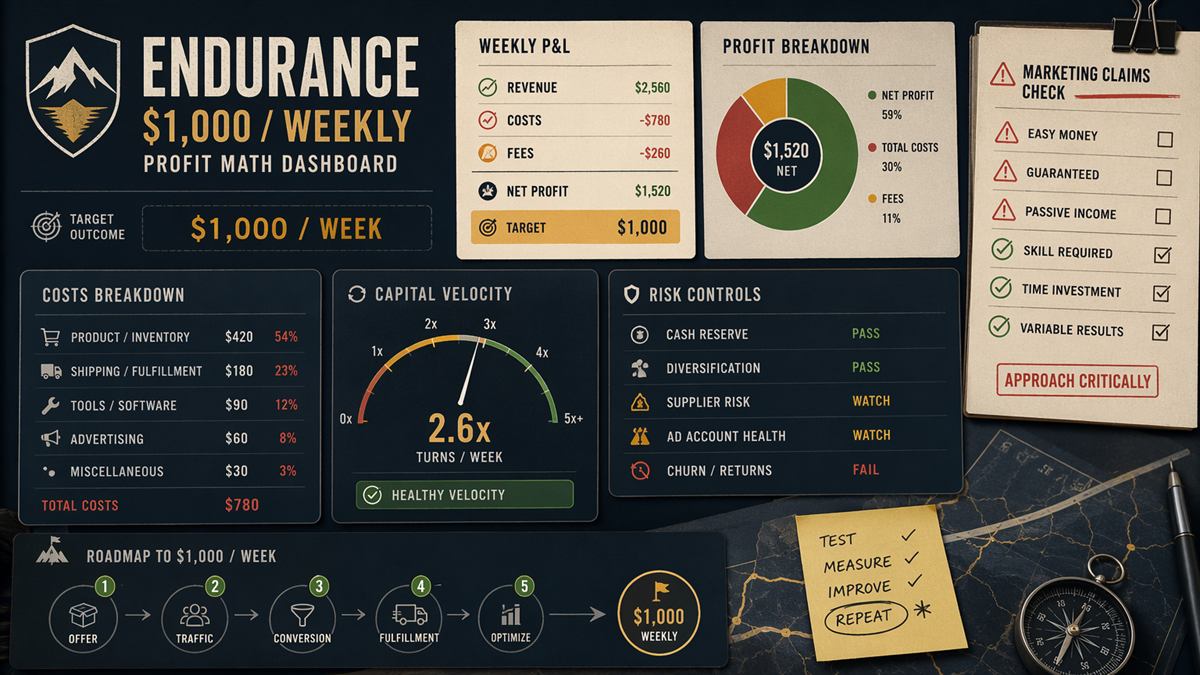
The honest math behind $1,000 weekly is demanding. If your average net profit per flip is $20, you need 50 profitable flips in a week. If your average net profit is $50, you need 20 profitable flips. If your average net profit is $100, you need 10 profitable flips. That assumes no major losses, cancellations, returns, slow inventory, or capital constraints.
This article shows the math so you can evaluate Endurance without hype. For the broader review, read Endurance Review 2026. For beginner expectations, read Endurance Beginner Guide. For pricing, read Endurance Pricing.
The One Lie: $1,000 Weekly Is The Beginner Baseline
The lie is that $1,000 weekly is the standard outcome for joining a paid reselling group.
It is not.
Could an experienced reseller make $1,000 in a strong week with the help of a paid community, monitors, tools, and deal flow Possibly. But possible is not the same as probable, and it is definitely not the same as guaranteed.
A $1,000 week requires multiple things to go right. You need enough opportunities. You need enough capital to buy inventory. You need fast enough alerts. You need good product selection. You need margins that survive fees. You need products to ship. You need buyers. You need few or no returns. You need a selling process.
A beginner usually lacks several of those pieces. They may not know which products sell. They may not have marketplace accounts. They may underestimate fees. They may overbuy hype products. They may miss alert windows. They may confuse revenue with profit.
This is why the $1,000 weekly frame should be treated as a ceiling or advanced scenario, not a beginner promise.
The One Fix: Separate Possible From Probable
The fix is to separate possible from probable.
Possible means something could happen under the right conditions. Probable means it is a reasonable expectation for a specific person with specific resources.
For an experienced reseller with capital, category knowledge, existing seller accounts, shipping systems, and time to act on alerts, Endurance may help find enough opportunities to support strong weeks. The group's monitors, Gargantua AIO Bot, restock information, FBA tools, E-Deals, and category breadth can all contribute.
For a beginner with little capital and no process, the probable first outcome is learning, not $1,000 weekly profit.
That does not make Endurance bad. It makes expectations important.
A strong trial goal is not "make $1,000 this week." A better trial goal is "can Endurance help me identify and evaluate enough opportunities to justify the subscription" Once that is proven, you can scale cautiously.
The One Number: Net Profit After All Costs
The one number is net profit after all costs.
Gross revenue is not profit. Gross spread is not profit. Marketplace screenshots are not profit.
Net profit subtracts:
- Product cost.
- Sales tax.
- Shipping to you.
- Shipping to buyer.
- Marketplace fees.
- Payment processing.
- Packaging.
- Returns.
- Cancellations.
- Damaged inventory.
- Storage.
- Subscription costs.
- Additional tools.
- Time.
If you buy a product for $100 and sell it for $140, you did not automatically make $40. Fees, shipping, tax, and time can reduce the result sharply.
A $1,000 weekly claim only matters if it means net profit. If it means revenue, it is much less impressive. A reseller can move $1,000 of product and keep very little.
Endurance should be evaluated by whether it improves net outcomes, not by whether it creates exciting activity.
What Endurance Can Actually Provide
Endurance can provide opportunity infrastructure.
Custom monitors can help members see restocks, drops, price changes, and deals faster. Gargantua AIO Bot may support execution workflows where automation is relevant. Insider restock alerts may help members prepare before public attention spikes. Amazon FBA tools may support sourcing decisions. E-Deals and food deals can create savings. Category breadth can give members multiple lanes instead of relying only on one market.
These are real inputs.
Endurance can also provide community context. Members may learn which categories are active, what mistakes to avoid, which deals are weak, and where timing matters. A good community can reduce research time and improve decision-making.
But inputs are not outcomes. A member has to turn them into action.
For component details, read What Is Endurance, Endurance Monitors Explained, and Gargantua AIO Bot Review.
What Endurance Cannot Provide
Endurance cannot guarantee inventory. It cannot guarantee successful checkouts. It cannot guarantee resale demand. It cannot guarantee shipping. It cannot guarantee no returns. It cannot guarantee that a beginner will understand the tools. It cannot guarantee $1,000 weekly.
It also cannot create capital. If you do not have money to buy inventory, you cannot scale resale profit. E-Deals and food discounts may still create savings, but savings are different from business income.
Endurance cannot remove competition. If many people see the same opportunity, resale prices can drop. If a restock is limited, most members may miss it. If a price error is canceled, the expected profit disappears.
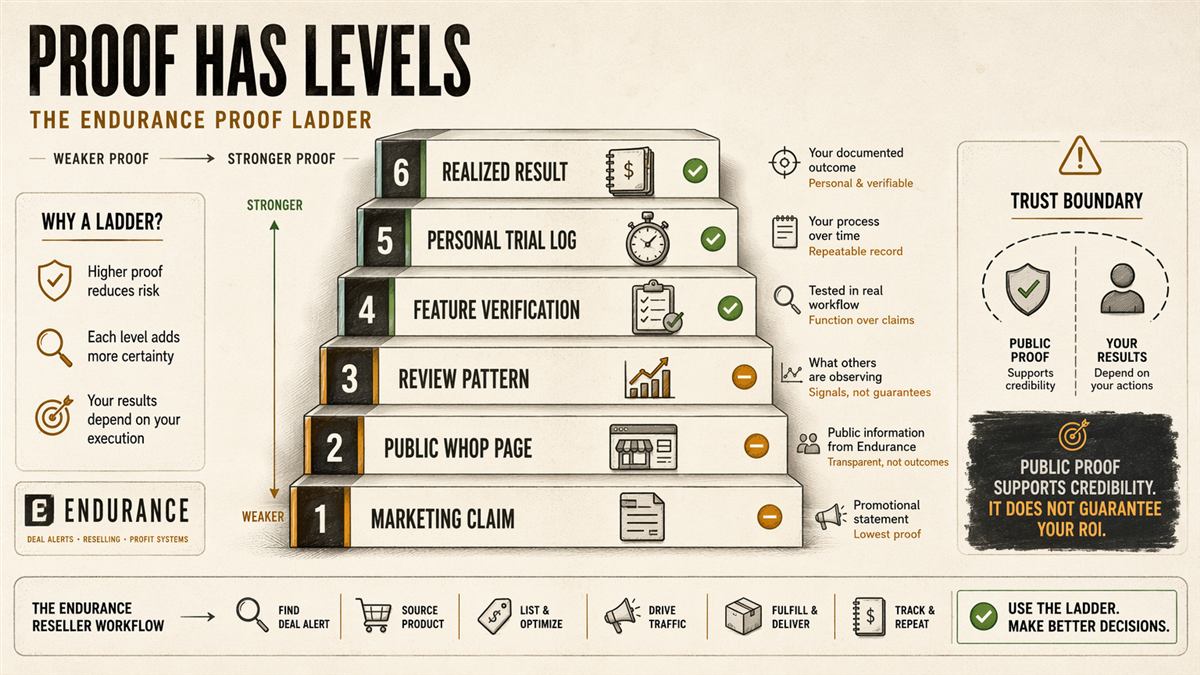
This is why honest content needs caveats. A product can be legitimate and still not produce a specific result for every user.
The $1,000 Weekly Math
Here is the basic math.
| Average Net Profit Per Win | Wins Needed For $1,000 Net Weekly |
|---|---|
| $10 | 100 wins |
| $20 | 50 wins |
| $50 | 20 wins |
| $100 | 10 wins |
| $250 | 4 wins |
| $500 | 2 wins |
This table shows why $1,000 weekly is hard. Smaller flips require volume. Larger flips require capital and risk tolerance.
A $20 net flip may be realistic on some small deals, but doing 50 of them in a week requires enormous deal flow, time, shipping, tracking, and operational discipline. A $100 net flip requires fewer wins but usually more capital and higher risk. A $500 net flip is rare and should not be a normal expectation.
Endurance may help members find opportunities. It does not change the arithmetic.
Scenario 1: Small Deal Flips
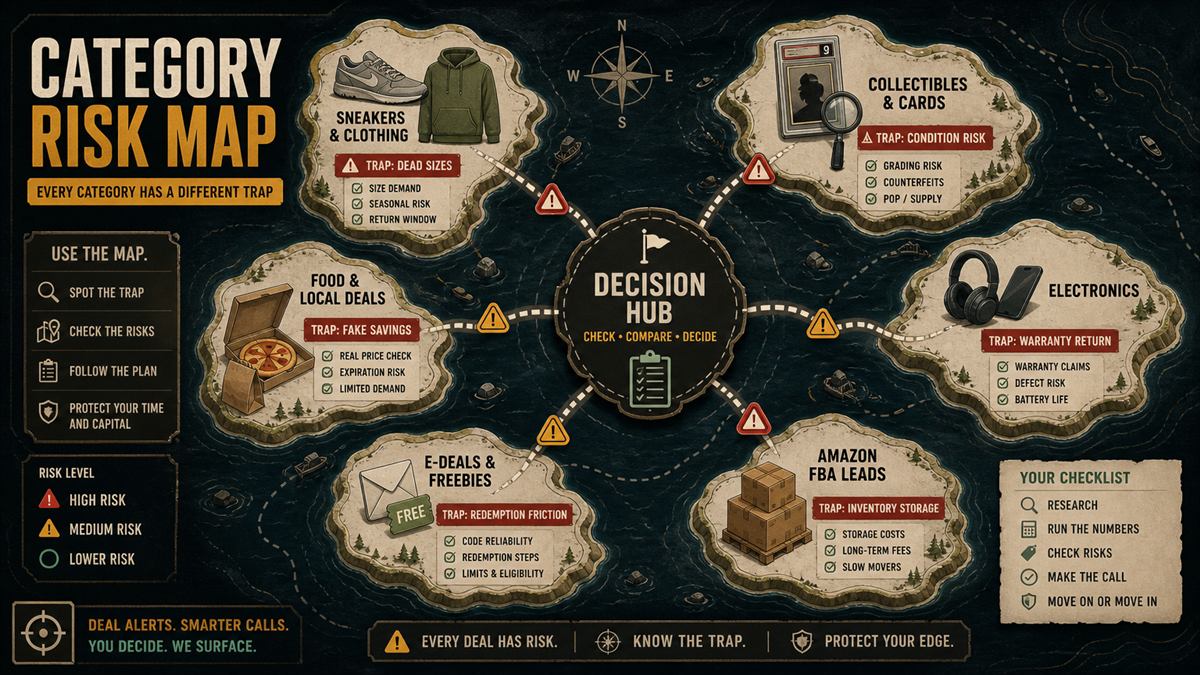
Small deal flips may come from E-Deals, food promotions, clothing discounts, small electronics, or retail arbitrage. They are attractive because risk per item can be lower.
But small profits require volume. If your average net profit is $10, you need 100 wins to reach $1,000. That is a lot of buying, listing, shipping, customer handling, and tracking.
For most beginners, small flips are better for learning than for chasing large weekly income. They help you understand fees, demand, and workflow. They can also offset the membership cost.
If Endurance helps you find enough small wins to cover the live weekly price or the referenced monthly price, that may be a successful early result even if it is far from $1,000 weekly.
Scenario 2: Sneakers And Collectibles
Sneakers and collectibles can produce stronger per-item profit, but they are inconsistent.
A sneaker restock may net $30, $50, $100, or nothing depending on pair, size, fees, timing, and market movement. A collectible may have strong demand but slow sell-through. Pokemon or trading-card products may restock and then cool if supply expands.
If your average net profit is $50, you need 20 successful wins in a week to hit $1,000. That is difficult, especially after missed checkouts and weak releases.
Endurance monitors and restock information may improve your chances of seeing opportunities. Gargantua AIO may support execution in some workflows. But the member still has to select profitable products and exit well.
For the sneaker-specific workflow, read Endurance For Sneaker Reselling. For other categories, read Endurance For Pokemon, Collectibles, Electronics, And Clothing.
Scenario 3: Electronics And Higher-Ticket Deals
Electronics can make $1,000 weekly look more achievable because per-item profit can be larger. If one electronics flip nets $100, ten wins could reach $1,000. If one nets $250, four wins could do it.
But electronics carry higher risks. Returns can be expensive. Fraud can happen. Warranties and serial numbers matter. Prices can drop quickly. Shipping and insurance cost more. Marketplace rules may be stricter.
A beginner should be careful with electronics because one mistake can erase many smaller wins.
Endurance may help surface electronics price drops, restocks, or deals, but the buyer needs strict filters. Do not chase higher dollar amounts without understanding downside.
Scenario 4: Amazon FBA Sourcing
Amazon FBA sourcing can produce meaningful profit for experienced sellers, but it is operationally complex.
FBA profit depends on product cost, referral fees, fulfillment fees, inbound shipping, prep, storage, restrictions, sales rank, buy-box competition, refunds, and account health. A product that looks profitable outside Amazon may fail after FBA costs.
Endurance's Amazon FBA tools may help members evaluate or source opportunities, but FBA is not casual flipping. Beginners need to learn the model before scaling.
A $1,000 FBA week is possible for some sellers, but it generally requires capital, volume, research skill, and operational systems. Endurance can be one input, not the whole business.
Why Savings Are Not The Same As Income
Endurance also includes E-Deals and free or discounted food. These can be valuable, but they are not the same as income.
If you save $20 on food you would have bought anyway, that is real household value. It can help offset membership cost. But it is not resale profit. If you buy something only because it is discounted, the "savings" may be spending.
For evaluating $1,000 weekly income, keep savings separate from profit. You can have three buckets:
- Resale net profit.
- Useful savings.
- Learning value.
All three can matter. Only the first is income.
Who Could Realistically Chase $1,000 Weekly
The buyer most likely to chase $1,000 weekly already has:
- Resale experience.
- Buying capital.
- Marketplace accounts.
- Shipping systems.
- Category knowledge.
- Time to act on alerts.
- Fee-aware tracking.
- Risk tolerance.
- Ability to use monitors and tools.
- Discipline to skip weak buys.
For this person, Endurance may be a useful edge. It can provide alerts, tools, and categories that feed an existing system.
The key phrase is existing system. Endurance can support a system. It should not be expected to create the entire system instantly.
Who Should Not Chase $1,000 Weekly
Do not chase $1,000 weekly if you are a beginner, undercapitalized, or still learning fees. Do not chase it if the subscription itself strains your budget. Do not chase it if you feel pressure to buy risky inventory. Do not chase it if you cannot handle returns or shipping. Do not chase it if you cannot track profit.
A better beginner target is to break even on the membership, then build toward consistent small wins. Once your process is proven, you can scale gradually.
Read Endurance Beginner Guide and Endurance Trial Checklist before thinking about large weekly targets.
Trial Checklist
- Verify current pricing on Whop.
- Decide whether you are measuring weekly, monthly, or annual value.
- Pick one category.
- Track net profit, not revenue.
- Separate savings from income.
- Include fees, shipping, returns, and subscription cost.
- Compare Endurance against free sources.
- Avoid scaling until small tests work.
- Treat $1,000 weekly as advanced, not baseline.
- Decide before renewal based on measured results.
Related Endurance Guides
- Endurance Review 2026
- Is Endurance Legit
- Who Is Keith Adam
- What Is Endurance
- Endurance Pricing
- Gargantua AIO Bot Review
- Endurance For Sneaker Reselling
- Endurance For Pokemon, Collectibles, Electronics, And Clothing
- Endurance Monitors Explained
- Endurance Vs Free Cook Groups
- Endurance Beginner Guide
- Endurance Trial Checklist
- Endurance Reviews
- Endurance Alternatives
FAQ
Can Endurance help me make $1,000 weekly
It may help some experienced users find opportunities that contribute to strong weeks, but $1,000 weekly should not be treated as guaranteed or as a normal beginner result.
What does someone need to make $1,000 weekly reselling
They usually need capital, deal flow, category knowledge, fast execution, selling systems, fee-aware tracking, and risk control.
Does Endurance guarantee profit
No. Endurance can provide monitors, tools, alerts, and community context, but outcomes depend on the member.
Is $1,000 weekly revenue the same as profit
No. Revenue is sales volume. Profit is what remains after costs, fees, shipping, returns, and subscription expenses.
Where can I join Endurance
Use this link: https://whop.com/endurance/endurance?a=digitalartlab
Final Verdict
Endurance can help the right member find opportunities, but it should not be sold or understood as a guaranteed $1,000 weekly system. Check the live Whop listing for current rating, review count, joined count, plan options, and checkout price. Whop's review describes Endurance as launched in 2018 by Keith Adam and highlights Gargantua AIO Bot, monitors, restock alerts, FBA tools, E-Deals, food deals, and broad resale categories.
That stack can support serious reselling. It cannot remove math.
A realistic beginner goal is to test whether Endurance can beat its subscription cost. A realistic intermediate goal is consistent net value. A $1,000 weekly goal belongs to experienced, capitalized users with systems already in place.
Join Endurance here: https://whop.com/endurance/endurance?a=digitalartlab